
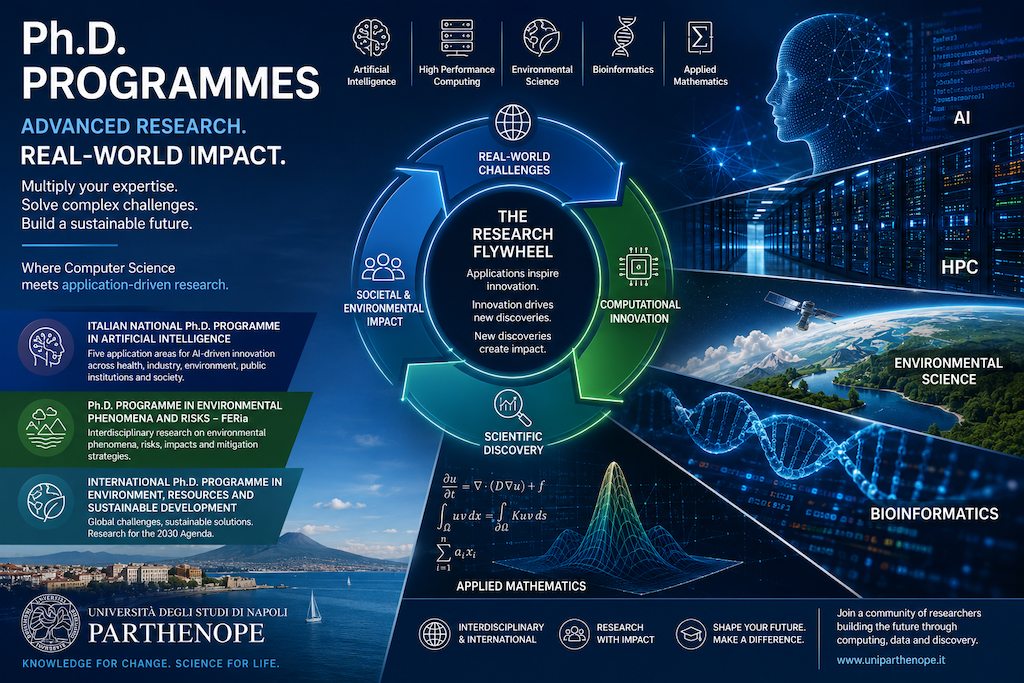
A degree in Computer Science opens the door to far more than traditional software development. Through doctoral research, computer scientists can combine advanced computing methods with artificial intelligence, environmental science, engineering, biology, sustainability, and the study of complex natural and social systems.
These interdisciplinary encounters create a research flywheel: challenging applications inspire new computational methods, while advances in algorithms, data analysis, modelling, and high-performance computing make previously inaccessible scientific questions solvable.
At the University of Naples “Parthenope” and through its broader national research network, graduates can pursue doctoral pathways in which Computer Science becomes both a field of advanced study and an enabling science for discovery.
The Application-Driven Research Flywheel
Application-driven research is not simply the use of existing software to address a practical problem. It is a continuous process of mutual advancement.
A complex environmental, biological, industrial, or societal challenge generates new computational requirements. These requirements stimulate the development of better algorithms, models, infrastructures, and data-management methods. The resulting innovations can then be transferred to other scientific fields, generating new questions, collaborations, datasets, and technological opportunities.
Through this flywheel effect, doctoral researchers can multiply their expertise across several interconnected areas:
- artificial intelligence and machine learning;
- high-performance and distributed computing;
- scientific computing and numerical simulation;
- big-data analytics and knowledge extraction;
- environmental and climate modelling;
- remote sensing and geospatial information;
- bioinformatics and computational biology;
- risk assessment and decision-support systems;
- sustainable development and natural-resource management.
Italian National Ph.D. Programme in Artificial Intelligence
The Italian National Ph.D. Programme in Artificial Intelligence is a federated initiative bringing together more than 60 universities and research institutions. It consists of five coordinated doctoral courses sharing a common foundation in AI while specialising in strategically important application areas.
The programme provides advanced training in the foundations and development of artificial intelligence while promoting a systemic and multidisciplinary understanding of AI technologies. Doctoral candidates participate in shared foundational and specialised activities and can benefit from national and international mobility opportunities.
Its five application areas are:
AI for Health and Life Sciences
This pathway explores the integration of AI, data science, the Internet of Things, biorobotics, biological research, and medicine. Relevant research areas include precision medicine, biomedical data analysis, diagnostic and therapeutic decision support, computational models, digital-health systems, and human-centred healthcare technologies.
For computer scientists, this area provides opportunities to work at the intersection of machine learning, bioinformatics, medical imaging, computational biology, data integration, and trustworthy clinical decision-support systems.
AI for Industry
The industrial pathway addresses the role of AI and robotics in intelligent production systems. Research topics include predictive maintenance, automated quality control, adaptive manufacturing, machine vision, planning, reasoning, distributed intelligence, and Internet of Things and edge-computing architectures.
It is particularly suitable for researchers interested in translating advanced computer-science methods into prototypes, industrial systems, patents, technology transfer, and innovative enterprises.
AI for Agrifood and the Environment
This area applies artificial intelligence to agriculture, ecosystems, environmental monitoring, and the management of natural resources. It includes precision agriculture, satellite and drone data, climate-risk analysis, decision-support systems, biodiversity monitoring, biosensors, food-chain traceability, and the assessment of responses to extreme environmental events.
Computer scientists can contribute expertise in Earth-observation data processing, machine learning, computer vision, geospatial computing, simulation, sensor networks, and scalable environmental data infrastructures.
AI for Government and Public Bodies
This pathway addresses secure, resilient, trustworthy, and intelligent digital systems for institutions and society. Relevant topics include cybersecurity, privacy, critical infrastructures, knowledge representation, machine learning, planning, natural-language processing, computer vision, blockchain, and distributed systems.
It provides a setting in which methodological AI research can be connected to public services, security, digital governance, and the responsible deployment of computational technologies.
AI for Society
The AI for Society pathway combines artificial intelligence, data science, network science, and computational social science. It investigates complex phenomena such as human mobility, urban dynamics, migration, community wellbeing, online communication, opinion formation, and the societal effects of AI.
Its research also encompasses explainable AI, human-centred systems, AI for social good, ethical design, inclusion, sustainability, and the social acceptability of intelligent technologies.
Ph.D. Programme in Environmental Phenomena and Risks — FERIa
The Ph.D. Programme in Environmental Phenomena and Risks, known as FERIa, provides advanced and innovative doctoral training for research careers in universities, public institutions, public administrations, research organisations, and private companies.
The programme studies a broad range of environmental phenomena, the risks associated with them, their possible consequences for people and productive systems, and the strategies through which those risks can be mitigated. Its defining characteristic is the convergence of methods and knowledge from several scientific and technological disciplines.
Research may begin with the climate system and the multiscale interactions among the atmosphere, hydrosphere, cryosphere, biosphere, and lithosphere. It then extends to the assessment of hazardous events, exposed elements, vulnerability, impacts, and integrated mitigation strategies.
The Contribution of Computer Science
Environmental risks are increasingly studied through computationally intensive and data-intensive approaches. Computer scientists can contribute to FERIa research through:
- numerical and stochastic modelling;
- high-performance simulation;
- machine learning for hazard detection and forecasting;
- satellite, radar, sensor, and geospatial data processing;
- scientific workflows and reproducible research;
- uncertainty quantification;
- digital twins of environmental systems;
- visual analytics and decision-support platforms;
- cloud, edge, and distributed computing infrastructures;
- early-warning and risk-communication systems.
The application domain provides demanding scientific problems, while Computer Science supplies the models, algorithms, software architectures, and computational resources needed to investigate them. In turn, these challenges stimulate advances in scalable computing, data assimilation, intelligent monitoring, and scientific software engineering.
International Ph.D. Programme in Environment, Resources and Sustainable Development
The international Ph.D. programme in Environment, Resources and Sustainable Development aims to educate future intellectual leaders in environmental science, ecology, and sustainable development. Its research addresses both local and global environmental challenges, with particular attention to the United Nations 2030 Agenda and its Sustainable Development Goals.
The programme adopts a strongly interdisciplinary and systems-based approach, studying environmental and socioecological systems across scales ranging from molecules to entire ecosystems. Special attention is given to human–nature interactions, nature conservation, sustainable resource management, and the development of practical sustainability models and strategies.
Its scientific scope encompasses fields including:
- biology and ecology;
- environmental chemistry;
- environmental physics;
- environmental modelling;
- geomatics;
- environmental accounting;
- life-cycle assessment;
- natural-resource management.
The programme is associated with the UNESCO Chair in Environment, Resources and Sustainable Development, established to support research, education, international cooperation, knowledge transfer, and scientific contributions to sustainable-development policies.
English is the official language of the programme, and international mobility is a required component. Doctoral training combines coursework with applied research conducted under academic supervision and is complemented by the publication of results in peer-reviewed international journals.
Computing for Sustainability
Computer scientists entering this programme can apply and extend their expertise in areas such as:
- computational ecology;
- environmental informatics;
- climate and ecosystem modelling;
- biodiversity data science;
- bioinformatics;
- geographic information systems;
- remote sensing;
- environmental digital twins;
- machine learning for sustainability;
- optimisation of natural-resource use;
- life-cycle and environmental data analysis;
- scientific data infrastructures;
- citizen science and environmental monitoring.
Research questions originating in ecology and sustainability often involve heterogeneous datasets, interacting processes, nonlinear behaviour, uncertainty, and multiple spatial and temporal scales. Addressing these challenges requires more than conventional data analysis: it demands new computational models, robust software, scalable infrastructures, and close cooperation between computer scientists and domain experts.
Multiplying Expertise Through Interdisciplinary Research
These doctoral programmes allow computer scientists to move beyond a single disciplinary boundary without abandoning their core identity.
A researcher may begin with machine learning and acquire expertise in environmental observation. Another may start from high-performance computing and progress towards climate-risk simulation. A software engineer may specialise in reproducible scientific workflows, while a data scientist may develop new methods for biological, ecological, or geospatial information.
This process does not dilute Computer Science. It strengthens it.
By working on application-driven research, doctoral candidates learn to:
- formulate computational research questions from real scientific needs;
- communicate across disciplinary boundaries;
- manage complex and heterogeneous research data;
- design reliable and reproducible computational experiments;
- evaluate models in scientifically meaningful contexts;
- translate research outputs into operational tools;
- understand the ethical, societal, and environmental consequences of technology;
- contribute to international research communities and collaborative projects.
From Algorithms to Impact
The most significant advances often occur where disciplines meet.
Artificial intelligence becomes more robust when tested against complex scientific evidence. High-performance computing develops through the demands of increasingly detailed simulations. Applied mathematics gains new relevance through environmental, biological, and industrial models. Data science evolves when confronted with incomplete, uncertain, distributed, and continuously changing observations.
At the same time, environmental science, healthcare, agriculture, public institutions, and sustainable development benefit from the capacity of Computer Science to transform data into knowledge and knowledge into action.
These Ph.D. pathways offer computer scientists the opportunity to become not only specialists in advanced technologies, but also interdisciplinary researchers capable of addressing some of the most important scientific and societal challenges of our time.
Explore the Programmes
Discover the doctoral pathway that best matches your interests, research ambitions, and desired field of impact:
- Italian National Ph.D. Programme in Artificial Intelligence
- Ph.D. Programme in Environmental Phenomena and Risks — FERIa
- International Ph.D. Programme in Environment, Resources and Sustainable Development
Applications, available positions, scholarships, deadlines, and admission requirements may change for each doctoral cycle. Prospective candidates should consult the official programme and University pages for the current call.